

I used to think talent got Actors booked in Kenya - Then I learned what casting really sees

Being a “Good Actor” is not always enough to get cast
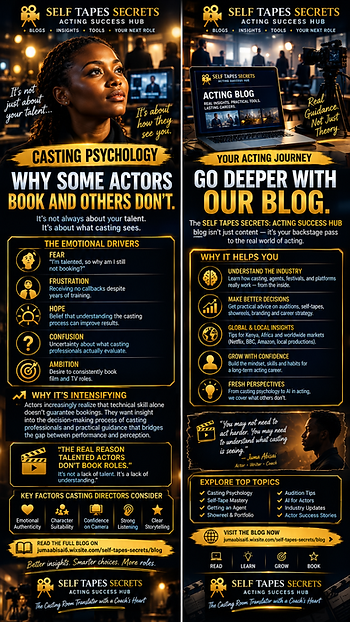
Casting psychology: Why some Actors book and others do not
Why are some talented actors constantly getting callbacks while others equally trained, equally ambitious, sometimes even equally good keep hearing nothing?
Here is the uncomfortable answer:
Casting is not simply a talent competition.
And once you understand that, the entire way you approach auditions can change.
You can spend years improving your acting technique, memorising scripts, attending classes, recording self-tapes and waiting for that one email that says “We'd like to see you again.”
Then comes the silence.
Again.
And again.
Eventually, the question becomes painfully personal:
«“If I'm actually good, why am I not booking?”»
That question sits at the heart of SELF TAPES SECRETS: ACTING SUCCESS HUB, the acting blog created to help actors understand not only how to act, but how to navigate the psychology, preparation, visibility and professional realities surrounding an acting career.
"Explore SELF TAPES SECRETS: ACTING SUCCESS HUB" (https://reference-url-citation.invalid/2)
The blog's central idea is simple:
Talent matters. But talent needs translation.
And that is where the Casting Room Translator with a Coach's Heart comes in.
---
Featured Snippet: Why Do Some Actors Book Roles and Others Don't?
Casting decisions are influenced by more than acting ability. Emotional authenticity, character suitability, preparation, professionalism, listening, camera presence and the actor's ability to make a believable connection with the material can all affect whether a performance creates interest.
Not getting a role does not automatically mean an actor gave a bad performance. Casting may also depend on chemistry, physical fit, creative direction, production requirements and how the actor fits the overall combination of performers.
That distinction is crucial.
Because if you think every rejection means “I'm not talented enough,” you will keep trying to fix the wrong problem.
---
The Acting Problem Nobody Warned You About
Imagine two actors.
Let's call them Amina and David.
Amina has trained for years. She knows her technique. She understands emotional preparation. She can cry on cue.
David has less training.
But when he walks into the scene, something happens.
You believe him.
He listens.
He responds.
He doesn't appear desperate to impress you.
He makes a specific choice.
And somehow, five minutes later, you remember him.
This is where many actors become frustrated.
They think:
“But Amina is technically better.”
Maybe she is.
But casting is not an examination where someone hands you a certificate for achieving the highest acting score.
The real question is often closer to:
“Can I see this person living inside this story?”
That is a different question.
And it changes how you prepare.
---
The Casting Psychology Gap
Most acting education concentrates on the craft:
- Character development
- Voice
- Movement
- Emotional preparation
- Scene study
- Improvisation
- Script analysis
Those skills matter enormously.
But there is another layer:
Perception.
How does your preparation read on camera?
How does your character choice communicate?
Does your performance feel specific or generic?
Are you listening or simply waiting to deliver your next line?
Does your confidence look grounded—or does it look like you're trying very hard to appear confident?
Does the viewer understand what you want?
Does your self-tape make them curious about what happens next?
This is the space where casting psychology becomes useful.
Not because actors should manipulate casting directors.
Quite the opposite.
The goal is to understand the viewing experience so you can make stronger, clearer choices.
---
What Casting Professionals May Be Looking For
There isn't one universal casting checklist.
But your performance can communicate several things very quickly.
1. Emotional Authenticity
The actor isn't simply demonstrating emotion.
The actor is experiencing the circumstances of the character.
That distinction can be enormous on camera.
A performance can be technically impressive while still feeling emotionally manufactured.
Your job isn't to show:
«“Look how emotional I can be.”»
Your job is to make us forget you're demonstrating anything.
That is why authenticity has become such a recurring theme throughout SELF TAPES SECRETS.
One of the site's articles asks why some actors feel instantly believable before they even speak, pointing toward something many performers overlook: the moment before the scene begins.
That tiny space matters.
Your body is already telling the story.
---
2. Character Suitability
Here's another uncomfortable truth:
You can give a brilliant audition and still not be the right actor for the role.
Perhaps the production needs a different age range.
Perhaps your chemistry with another actor doesn't work.
Perhaps your physicality doesn't match the character.
Perhaps the director sees the character differently.
Perhaps another actor simply fits the overall ensemble better.
StageMilk similarly explains that callbacks can involve testing different actor combinations because casting teams need to understand how performers work together on screen.
So stop turning every rejection into a verdict on your talent.
Sometimes:
“No” means “not this role.”
Not:
“You are not good enough.”
That psychological distinction can protect your career.
---
3. Watchability
This is one of the most useful concepts an actor can develop.
Ask yourself:
“If I weren't the actor in this tape, would I want to keep watching?”
Not because you need to become flashy.
Because screen acting is an attention-based medium.
Your job is to create a believable human being that makes the audience want to remain in the scene.
This is why the SELF TAPES SECRETS blog repeatedly explores ideas such as:
- The moment before
- Camera presence
- Character choices
- Self-tape psychology
- Emotional authenticity
- Why great self-tapes can still be ignored
- Why talent alone does not guarantee visibility
The blog currently describes its purpose as practical acting advice, audition strategies, self-tape techniques and career insights for actors in Kenya and worldwide.
That combination is important.
Because actors don't just need acting lessons.
They need career translation.
---
From “Acting” to “Being Castable”
Here's the shift I want you to make.
Don't ask only:
«“How can I become a better actor?”»
Ask:
«“How can I become a more prepared, watchable, adaptable and castable actor?”»
Those are not identical questions.
A technically strong actor might still struggle with:
- Poor self-tape framing
- Weak eyelines
- Generic character choices
- Unclear objectives
- Overacting
- Poor preparation
- Lack of professional materials
- Weak online visibility
- Inability to take direction
- Emotional burnout
- Not understanding how representation works
And suddenly the puzzle looks different.
The problem wasn't necessarily the actor.
The problem was the system surrounding the actor.
---
This Is Why the Acting Success Hub Matters
The SELF TAPES SECRETS blog isn't designed as another endless collection of:
“10 acting tips you need today!”
Its stronger opportunity is the connection between craft + audition psychology + industry awareness + career development.
Look at the subjects already appearing across the hub.
One article challenges the belief that talent alone creates success. Another explores the nervous-system side of freezing during auditions. Another examines why great self-tapes can still be ignored. Another explores personal branding and visibility.
Notice the pattern?
The blog keeps asking a bigger question:
“What is actually happening around the actor?”
That is the fresh perspective.
---
Before vs. After: The Actor's Mental Shift
Before
You send a self-tape.
You obsess over it.
You check your email.
Nothing.
You watch the tape again.
You find one mistake.
You decide you're terrible.
You watch another actor's Instagram.
They booked.
You panic.
You send another audition.
Repeat.
After
You send the audition.
You evaluate what you controlled.
You record what you learned.
You move on.
You improve one measurable skill.
You build your professional toolkit.
You understand the casting process more clearly.
You prepare for the next opportunity.
That's not a motivational quote.
That's a career system.
And systems are what allow actors to survive long enough for opportunities to compound.
---
The Three-Step Casting Psychology Reset
If you have been struggling with acting callbacks, start here.
Step 1: Stop Treating Rejection as Diagnosis
A rejection is an outcome.
It isn't automatically an explanation.
Don't immediately conclude:
“My acting wasn't good enough.”
Instead ask:
- Was I aligned with the role?
- Was my character choice specific?
- Was my self-tape clear?
- Was I emotionally connected?
- Did I understand the brief?
- What could I improve next time?
That turns rejection into information.
---
Step 2: Watch Yourself Like a Casting Professional
Take your next self-tape and remove your actor ego.
Watch it once without analysing your performance.
Just observe.
Ask:
Would I keep watching?
Then watch again.
Look for:
- Clarity
- Presence
- Listening
- Specificity
- Emotional truth
- Character connection
- Camera awareness
You might discover something surprising.
The scene you thought was your weakest may actually be your most watchable.
---
Step 3: Build Your Own Casting Translation System
This is where SELF TAPES SECRETS: ACTING SUCCESS HUB becomes useful.
Don't consume acting advice randomly.
Use it to answer specific career questions.
Need better auditions? Study the audition and self-tape articles.
Struggling with confidence? Explore the psychological and preparation-focused material.
Trying to understand why talent isn't translating into opportunities? Explore the casting, visibility and career-development pieces.
Developing characters? Explore the character-development and on-camera acting material.
The blog already organizes its content around categories including Acting Tips, Film and Television Auditions, Audition Preparation, Casting Director Advice, Self Tape Auditions, Acting Career Development, Character Development and On Camera Acting.
That's not just content organization.
It's a learning pathway.
---
Why This Matters for Actors in Nairobi—and Everywhere Else
The geography of acting opportunity is changing.
An actor in Nairobi can prepare for an international self-tape.
A performer in London can study an American casting brief.
An actor in Los Angeles can collaborate remotely.
The audition room increasingly begins before you physically enter a room.
Self-tapes have expanded the geographic reach of casting, allowing producers and casting teams to see performers from wider locations. StageMilk notes that first-round auditions have increasingly moved into self-tape formats, changing the competitive environment for actors.
That means your education cannot stop at:
“Learn how to act.”
You need:
Act. Prepare. Record. Present. Understand. Adapt. Repeat.
---
The Bigger Idea: Stop Chasing the Mystery
There is a dangerous psychological trap in acting.
You start believing successful actors possess a secret.
Maybe they know the right person.
Maybe they're naturally charismatic.
Maybe they were born talented.
Maybe casting directors simply love them.
Sometimes opportunity absolutely involves timing, relationships, circumstances and luck.
But there are also things you can control.
Preparation.
Craft.
Character choices.
Self-tape quality.
Professionalism.
Listening.
Adaptability.
Career strategy.
Visibility.
And understanding what your performance communicates.
That is the territory SELF TAPES SECRETS: ACTING SUCCESS HUB is designed to explore.
---
The Casting Room Translator With a Coach's Heart
Think of this blog as sitting between two worlds.
On one side:
The actor.
“I just want to understand why this audition isn't working.”
On the other:
The industry.
“We need someone who fits this story, can deliver the material, take direction, work professionally and make the character believable.”
The translator's job is to connect those worlds.
Not by pretending to know exactly what every casting director thinks.
But by helping actors ask better questions.
Because better questions create better preparation.
And better preparation creates more opportunities to deliver the performance you've been training to give.
---
What Should You Do Next?
Don't wait until your next rejection to start learning how the casting ecosystem works.
Start with one question:
“What part of my acting career am I currently trying to improve?”
Then use the SELF TAPES SECRETS blog as your roadmap.
Read one article.
Take one idea.
Apply it to your next audition.
Record the result.
Measure what changed.
Then move forward.
And if you want to go deeper, explore the practical acting PDFs available through the SELF TAPES SECRETS shop. They are designed to turn individual questions—self-taping, character work, auditions, career development and industry navigation—into practical learning tools.
"Explore the SELF TAPES SECRETS acting PDFs on Payhip" (https://reference-url-citation.invalid/10)
---
Frequently Asked Questions
Why do talented actors get rejected?
Because casting is about fit as well as performance. Chemistry, character suitability, creative direction, production requirements and the overall ensemble can influence decisions.
Can acting technique guarantee bookings?
No. Technique can strengthen your preparation and performance, but no acting technique can guarantee a casting outcome.
What makes an actor memorable?
Usually, specificity, authenticity, believable listening, clear storytelling and a performance that feels connected to the character rather than designed simply to impress.
Why am I not getting acting callbacks?
There may be many possible reasons. Instead of assuming your talent is the problem, examine your preparation, character choices, self-tape presentation, role alignment and professional materials.
What is casting psychology?
In practical terms, it is understanding how your choices, presence and presentation are perceived during the casting process—and using that understanding to prepare more intentionally.
---
Your Career Doesn't Need More Mystery. It Needs More Translation.
The actor you want to become is probably not hiding somewhere inside another acting class.
They may be hiding inside a better understanding of the game.
The performer who eventually books the role may not be the actor who suddenly becomes twice as talented.
They may simply become better at translating their talent into something the camera, casting team and story can recognize.
That's the shift.
From talented to intentional.
From anxious to prepared.
From guessing to understanding.
From “Why didn't they choose me?” to “What can I learn from this?”
That is where an acting career begins to feel less like a lottery—and more like a craft you can deliberately keep developing.
And that is the reason SELF TAPES SECRETS: ACTING SUCCESS HUB exists.
Not to promise you a booking.
To help you become the actor who is increasingly ready when the right opportunity arrives.


Comments