

Casting Directors in Nairobi are watching Self tapes differently now - Here is what most Actors still miss

Updated: Oct 3
Your Self tape might be losing callbacks before the scene even gets interesting

The hidden science of Self tape evaluation: Why good Actors still get ignored and how to make your audition easier to watch
How do casting professionals evaluate self tapes?
Casting professionals generally assess four things at once; performance, role suitability, technical clarity and overall watchability. The strongest self tapes are not necessarily the most dramatic or polished. They are clear, emotionally specific, easy to watch and feel aligned with the role.
There is a moment almost every actor knows. You finish a Self tape, you feel good, maybe not perfect but good.
You found the charact, learned the lines, did three takes. You fixed the lighting and uploaded the file.
Then, silence, no callback, no explanation, nothing and suddenly, your brain becomes a very expensive detective agency.
Was my eyeline wrong? Did I overact? Was the framing too wide? Did they hate my performance? Did they even watch it?
Welcome to one of the most frustrating realities of modern acting auditions, you often do not get feedback.
That silence creates confusion and confusion creates bad habits.
Actors start changing everything at once. They become more intense. Then more subtle. Then more technical. Then more nervous. Just before long, the Self tape becomes a full production project and the actor forgets the one thing that mattered most: Can another human being watch this performance and quickly understand who you are, who the character is and why you belong in this role?
That question sits at the heart of Category 2 of SELF TAPES SECRETS on Payhip.
These guides are designed for actors who want more than generic advice like, "Just be confident."
They focus on the practical reality of modern auditions:
- How to prepare.
- How to rehearse.
- How to self tape.
- How to enter an audition room.
- How to stay present under pressure.
- How to make your performance easier to watch, understand and remember.
The audition process has changed and actors who understand the hidden science of self tape evaluation can stop guessing and start improving.
The new audition reality: You are being watched differently
A traditional audition room gave actors something valuable. Immediate human energy.
You could walk in, feel the room, adjust, listen, respond and build a relationship with the people watching.
A Self tape changes that. Now your performance may be watched:
- On a laptop.
- Between meetings.
- Alongside dozens or hundreds of other submissions.
- On different screen sizes.
- By people with limited time.
- Without you physically present to explain your choices.
That does not mean casting professionals are careless. It means clarity matters more than ever.
Your tape has to do some of the work your physical presence once did.
It has to communicate quickly. Not by shouting, by being watchable.
That is why a technically expensive self tape can still fail while a simple, emotionally honest audition creates interest.
The goal is not to make your audition look like a Netflix trailer. The goal is to remove distractions so your acting can be seen.
That distinction changes everything.
The hidden science of Self tape evaluation
When actors ask, "Why did I not get a callback?", they often assume the answer is talent.
Usually, the situation is more complicated.
A Self tape can be evaluated through several overlapping lenses.
Performance
Is the actor emotionally connected? Are they listening?
Are their choices specific? Does the performance feel lived rather than demonstrated?
Role suitability
Does this actor feel believable for this particular world?
Do their energy, interpretation, age range, presence and overall casting identity align with the role?
This does not mean there is only one "correct" actor. It means casting is often about fit as much as talent.
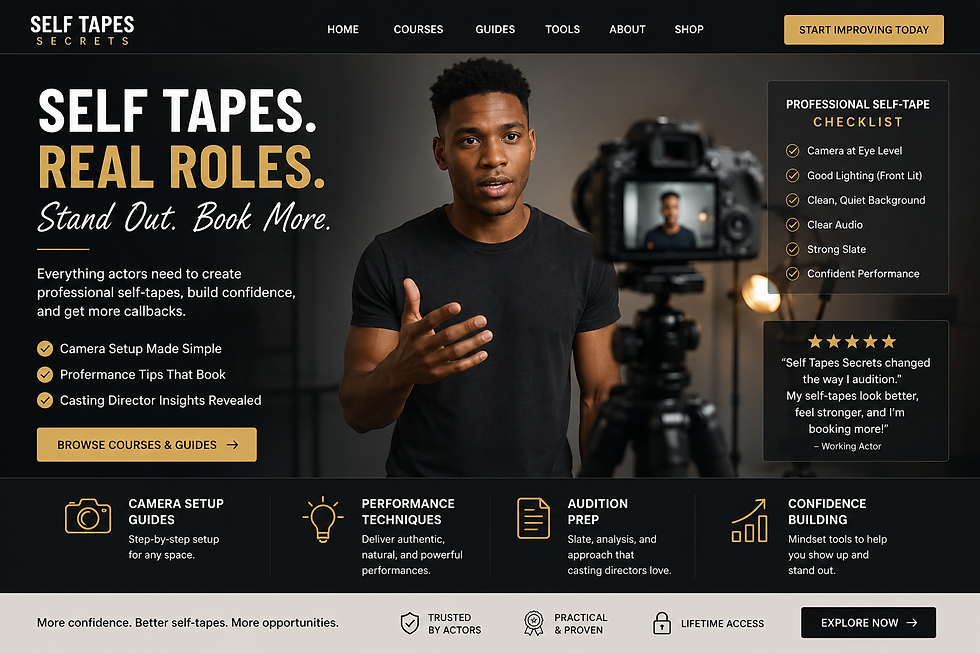
Technical clarity
Can the viewer clearly see and hear the actor?
Is the eyeline understandable? Is the framing distracting?
Does the sound interfere with the scene?
Technical mistakes matter because they create friction between the viewer and the performance.
Overall watchability
This is the invisible category and it is often where actors lose the plot.
Watchability is the combined experience of viewing the tape.
Does the performance pull you in? Or does something constantly push you away?
The strongest actors learn to review their own auditions from the viewer's perspective.
Not: "Did I feel like I acted well?" but: "If I knew nothing about myself, would this make me want to keep watching?"
That is a very different question.
CATEGORY 2: Your Self tape and audition success library
The Category 2 PDFs in my Payhip shop are built around one simple idea: A better audition is rarely created by one magic trick. It is created by improving the entire chain.
Preparation affects confidence. Confidence affects presence.
Presence affects performance. Performance affects watchability.
Watchability affects how easily people can remember you.
That is why these guides approach audition success from different angles.
GUIDELINES WHILE SELF TAPING: GUIDELINES ACTORS USE TO BOOK ROLES
Think of this guide as your practical self tape checkpoint.
Many actors know the obvious rules.
Good lighting, clear sound, neutral background but knowing the rules and applying them consistently are two different things.
GUIDELINES WHILE SELF TAPING helps actors think through the details that can quietly influence the viewing experience.
The benefit is not perfection. It is consistency.
You want to reach a point where the technical side of self taping becomes familiar enough that it stops stealing energy from your acting.
Imagine two actors. Actor One spends thirty minutes fighting with the camera, worrying about the background, changing outfits and adjusting the reader.
By the time the audition begins, they are already exhausted.
Actor Two has a repeatable process. The setup is simple, the environment is ready, the actor can focus on the scene.
Who has more emotional energy left for the performance?
Exactly. This PDF helps actors build a system and systems reduce panic.
For actors in Nairobi, Los Angeles, London or anywhere else in the world, professional self tape habits can make the audition process less chaotic.
You do not need a giant studio. You need clarity.
WHAT HAPPENS IN AN AUDITION ROOM: MASTER CONFIDENCE, PRESENCE AND PROFESSIONALISM
The audition room can feel like another planet. You know your lines outside.
Then suddenly someone says, "Whenever you are ready" and your brain forgets your own name.
Why? Auditions are not just acting events. They are pressure events.
This guide explores the human side of auditioning:
- Confidence.
- Presence.
- Professionalism.
- Preparation.
- Emotional control.
One of the biggest myths actors believe is: "Confident actors do not get nervous."
False. Confidence is not the absence of nerves. Confidence is knowing what to do while nerves are present.
That distinction can transform your audition psychology.
An actor who understands their process does not need to feel fearless before every audition.
They need a reliable way to return to the work.
This is especially valuable for actors who freeze, overthink, rush or become overly concerned with impressing everyone in the room.
The goal is not to walk into an audition saying: "I must book this."
The healthier focus is: "I am here to deliver a clear, prepared, truthful version of my work."
Ironically, that often creates more freedom and freedom is easier to watch than desperation.

SELF TAPE FOR FILM AND SERIES: WIN MORE ROLES FROM TELEVISION AND FILM FROM HOME
Self tapes are now part of the global acting conversation.
An actor may audition for projects without travelling to the casting location.
That creates opportunity. It also creates competition.
Your self tape is no longer competing only with actors in your immediate area. Your audition may exist in a much larger pool.
That is why SELF TAPE FOR FILM AND SERIES focuses specifically on the on camera experience.
Film and television acting demand attention to details that stage performers sometimes discover later:
- Framing.
- Stillness.
- Eyelines.
- Listening.
- Emotional scale.
- Camera awareness.
The camera notices things differently. Sometimes the smallest thought is enough.
Sometimes the actor who does less is actually communicating more ut subtlety does not mean emptiness.
A quiet performance still needs intention.
This guide helps actors think about how their work translates through the lens.
Not how to become "small." How to become specific.
That is a major difference.
HOW TO REHEARSE FOR A CHARACTER OR ROLE: REHEARSAL MASTERY
Here is a contrarian truth: Many self tape problems actually begin before the camera is switched on.
The actor may blame the lighting, the camera, nerves or reader but the real problem started during rehearsal.
Some actors rehearse until they become mechanical.
Others barely rehearse because they want to stay "natural." Both approaches can create problems.
Rehearsal mastery is about preparing deeply without becoming trapped inside your preparation.
HOW TO REHEARSE FOR A CHARACTER OR ROLE helps actors explore the character before the pressure of the audition begins.
The goal is to arrive with options. Not one frozen performance.
Ask:
- What does my character want?
- What are they hiding?
- Who are they speaking to?
- What changes during the scene?
- Where is the pressure?
- What happens if I make a different choice?
That exploration creates flexibility and flexibility is powerful.
Auditions rarely go exactly as planned. You may receive a direction.
You may need another take. You may discover something new.
Actors who only memorise results can struggle. Actors who understand the scene can adapt.
The five invisible Self tape mistakes Actors often miss
1. Starting too slowly
You do not need to rush but you do need to arrive.
Many actors take too long to enter the scene emotionally.
Give yourself a clear moment before the first line. Then commit.
2. Overacting the emotion
Emotion is not volume.
The audience should see what the character is experiencing, not see the actor trying to prove that emotion exists.
3. Weak or Cconfusing eyelines
Your eyeline helps build the invisible world of the scene.
If it is inconsistent or distracting, the relationship can become harder to believe.

4. Generic character choices
If ten actors could make exactly the same choices, your performance may lack specificity.
Ask what makes your interpretation different.
5. Forgetting the viewer
Actors understandably focus on the work but self tapes are communication.
Review your tape with fresh eyes:
. Can you hear everything?
. Can you follow the scene?
. Is anything distracting?
. Would you keep watching?
The 3 step Self tape evaluation system
Here is a simple system you can start using today.
Step 1: Watch without sound
Can you understand the character's focus and emotional journey visually?
Your body and face should support the story without becoming busy.
Step 2: Listen without watching
Does the voice feel connected? Is the pacing natural? Can you hear emotional changes?
Step 3: Watch like a stranger
Forget how hard you worked. Forget how many takes you did.
Forget what you intended. Watch only what actually appears on screen.
That final step can be uncomfortable. It can also be incredibly useful.
Why Category 2 is different
These four PDFs are not trying to sell you the fantasy that one technique will suddenly guarantee bookings.
No honest acting guide can promise that. Casting involves variables:
- Role requirements.
- Timing.
- Chemistry.
- Production needs.
- Availability.
- Experience.
- Interpretation.
What you can control is your preparation, clarity, professionalism, your self tape process and your ability to keep improving.
That is where Category 2 becomes valuable.
Each guide addresses a different part of the audition chain.
Together, they help actors move from: "I hope this tape works", to: "I understand how I prepared this, why I made these choices and what I will improve next time."
That is measurable growth and measurable growth creates confidence.
How casting professionals evaluate Self tapes
Casting professionals generally evaluate self tapes based on performance quality, role suitability, technical clarity and overall watchability. The most effective auditions are clear, emotionally authentic, well prepared and easy to follow. Common problems include generic choices, forced emotion, poor eyelines, weak audio and performances that feel disconnected from the character's situation. Actors can improve by developing consistent rehearsal systems, reviewing their own tapes objectively and focusing on clarity rather than overproduction.
How do casting professionals evaluate self tapes?
They generally consider performance, character suitability, presentation quality, clarity and whether the audition is engaging and easy to watch.
What makes casting professionals stop watching a Self tape?
There is no universal number of seconds or single reason. However, distracting technical problems, unclear choices, forced performances and a lack of emotional connection can reduce engagement.
Can small self tape adjustments improve callbacks?
Yes. Improvements in framing, sound, eyelines, pacing, preparation and emotional specificity can improve the overall viewing experience.
Do actors need expensive equipment?
Not necessarily. Clear sound, useful lighting, stable framing and a distraction free environment are often more important than expensive equipment.
Why should actors rehearse before self taping?
Rehearsal helps actors understand the scene, explore choices, build confidence and remain flexible when direction changes.

Your next step: Stop guessing and start building a process
The modern audition world can make actors feel invisible.
You submit, then wait.
You refresh your email, then nothing.
Silence does not mean you are talentless. It means you need a process that helps you learn from every opportunity, even when feedback does not arrive.
That is the purpose of the SELF TAPE AND AUDITION SUCCESS category inside SELF TAPES SECRETS.
Start with the problem you feel most strongly right now:
- Need a better self tape process? Explore GUIDELINES WHILE SELF TAPING.
- Freeze when the pressure begins? Read WHAT HAPPENS IN AN AUDITION ROOM.
- Want stronger on camera auditions? Dive into SELF TAPE FOR FILM AND SERIES.
- Feel prepared but somehow mechanical? Work through HOW TO REHEARSE FOR A CHARACTER OR ROLE.
You do not have to fix everything overnight.
Start with one weakness. Improve it.
Then move to the next because the actor who keeps refining their process becomes harder to ignore.
The next time you press record, the goal is no longer to hope someone gives you a chance.
The goal is to give them something clear, truthful, professional and worth remembering.
“Self Tape Tips for Actors in Kenya and Worldwide”:


Comments